Introduction
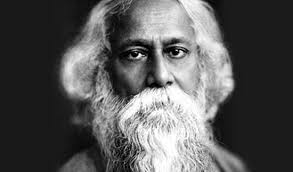
Rabindranath Tagore was one of the most influential figures in Indian and global cultural history. A poet, philosopher, musician, playwright, painter, and educationist, Tagore reshaped Bengali literature and music while contributing profoundly to the intellectual and cultural awakening of India during the late 19th and early 20th centuries. He became the first non-European to win the Nobel Prize in Literature in 1913, placing Indian literature on the world map. His works transcend national boundaries, blending spirituality, humanism, and artistic brilliance.
Early Life and Background
Rabindranath Tagore was born on May 7, 1861, in Kolkata (then Calcutta), into a wealthy and culturally vibrant family known as the Tagore family. His father, Debendranath Tagore, was a religious reformer and philosopher associated with the Brahmo Samaj movement, while his mother, Sarada Devi, played a traditional yet
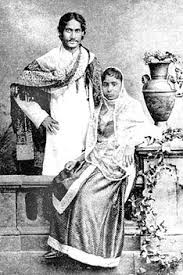
supportive role in his upbringing.
Tagore was the youngest of thirteen surviving children, and his family environment was rich in literature, music, art, and intellectual discussions. Unlike conventional schooling, Tagore disliked formal education and was mostly educated at home by tutors. This unconventional education allowed his creativity to flourish from an early age. He began writing poetry when he was just eight years old and published his first collection under a pseudonym as a teenager.
Education and Travels
Though Tagore initially resisted formal education, he was sent to England in 1878 to study law. He attended University College London but did not complete his degree. Instead, he immersed himself in English literature and Western music, which later influenced his own literary style.
His travels were not limited to England. Over his lifetime, Tagore visited many countries, including the United States, Japan, China, and various parts of Europe. These travels helped him interact with global thinkers and artists, shaping his universal outlook. He believed in the unity of humanity beyond national and cultural divisions.
Literary Contributions
Tagore’s literary works are vast and diverse, encompassing poetry, novels, short stories, essays, and plays. His poetry is particularly renowned for its lyrical beauty and philosophical depth.
Poetry
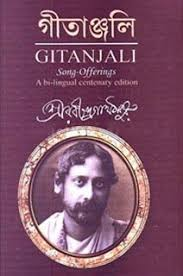
His most famous work, Gitanjali (Song Offerings), is a collection of spiritual poems that earned him the Nobel Prize. The poems express devotion, love, and the relationship between humans and the divine. His poetic language is simple yet profound, making it accessible to readers worldwide.
Novels and Short Stories
Tagore wrote several important novels such as Gora, Ghare-Baire (The Home and the World), and Chokher Bali. These works explore themes of identity, nationalism, social reform, and human relationships.
His short stories are considered pioneers of the genre in Bengali literature. Stories like Kabuliwala and The Postmaster depict everyday human emotions with remarkable sensitivity.
Plays and Essays
Tagore also wrote plays such as Dak Ghar (The Post Office), which reflects spiritual liberation. His essays addressed topics like education, nationalism, and social reform, often challenging rigid traditions and colonial ideologies.
Contribution to Music and Art
Tagore composed over 2,000 songs, collectively known as Rabindra Sangeet. These songs blend classical Indian music with folk traditions and Western influences. His compositions are deeply emotional and philosophical, covering themes such as love, devotion, nature, and patriotism.
Remarkably, two of his songs became national anthems:
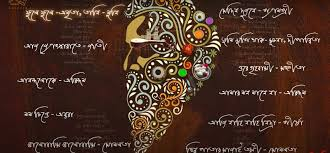
- “Jana Gana Mana” – National Anthem of India
- “Amar Shonar Bangla” – National Anthem of Bangladesh
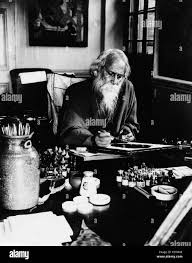
Later in life, Tagore also took up painting. His artworks, though unconventional, were exhibited internationally and appreciated for their originality.
Educational Philosophy and Visva-Bharati
Tagore was deeply dissatisfied with the rigid and colonial education system in India. He believed education should nurture creativity, individuality, and a connection with nature.
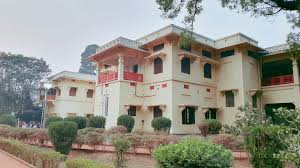
In 1901, he founded a school at Santiniketan, which later evolved into Visva-Bharati University. His educational philosophy emphasized learning in a natural environment, freedom of thought, and a blend of Eastern and Western knowledge systems.
Visva-Bharati became a center for cultural exchange, attracting scholars and students from around the world. Tagore envisioned it as a place “where the world makes a home in a single nest.”
Political Views and Nationalism
Although Tagore was a patriot, his views on nationalism were nuanced. He supported India’s freedom struggle but criticized aggressive nationalism and narrow-minded patriotism. He believed that true freedom comes from intellectual and moral development rather than mere political independence.
Tagore initially supported British rule for its potential to modernize India but later became critical of colonial exploitation. In 1919, after the Jallianwala Bagh massacre, he renounced his knighthood in protest, demonstrating his strong moral stance against injustice.
He also shared a complex relationship with other leaders like Mahatma Gandhi. While they respected each other deeply, they often differed in their approaches to nationalism and social reform.
Philosophy and Humanism
Tagore’s philosophy was rooted in humanism, spirituality, and universalism. He believed in the unity of all human beings and the importance of harmony between humans and nature.
His ideas were influenced by ancient Indian scriptures like the Upanishads, as well as Western philosophical thought. He rejected materialism and emphasized inner spiritual growth.
Tagore’s concept of freedom was not just political but also intellectual and emotional. He encouraged individuals to break free from ignorance, fear, and prejudice.
International Recognition
Tagore’s influence extended far beyond India. His Nobel Prize in Literature in 1913 marked a turning point in global recognition of non-Western literature. He delivered lectures across the world on topics like education, spirituality, and global unity.
He interacted with prominent figures such as Albert Einstein, W.B. Yeats, and Romain Rolland. His dialogues with Einstein, in particular, explored the relationship between science and spirituality.
Tagore’s works were translated into many languages, making him a global literary figure.
Later Life and Death
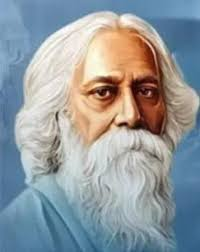
In his later years, Tagore continued to write, paint, and engage in intellectual pursuits despite declining health. He also expressed concern about global conflicts and the rise of aggressive nationalism, especially in the context of World War II.
Rabindranath Tagore passed away on August 7, 1941, in Kolkata. His death marked the end of an era, but his legacy continues to inspire generations.
Legacy and Influence
Tagore’s legacy is immense and multifaceted. He is regarded as the father of modern Bengali literature and a key figure in India’s cultural renaissance.
His contributions influenced literature, music, education, and political thought. Rabindra Sangeet remains an integral part of Bengali culture, and his literary works are studied worldwide.
Institutions like Visva-Bharati continue to uphold his vision of holistic education. His ideas on universal humanism remain relevant in today’s increasingly divided world.
Conclusion
Rabindranath Tagore was not just a literary genius but a visionary who sought to harmonize tradition with modernity, nationalism with universalism, and art with life. His works reflect deep insight into human nature and a profound love for humanity.
Even decades after his death, Tagore’s writings, songs, and ideas continue to inspire people across the globe. He stands as a symbol of creativity, wisdom, and the enduring power of human spirit.

Leave a Reply